Why Most Startup Apps Fail And How To Avoid It

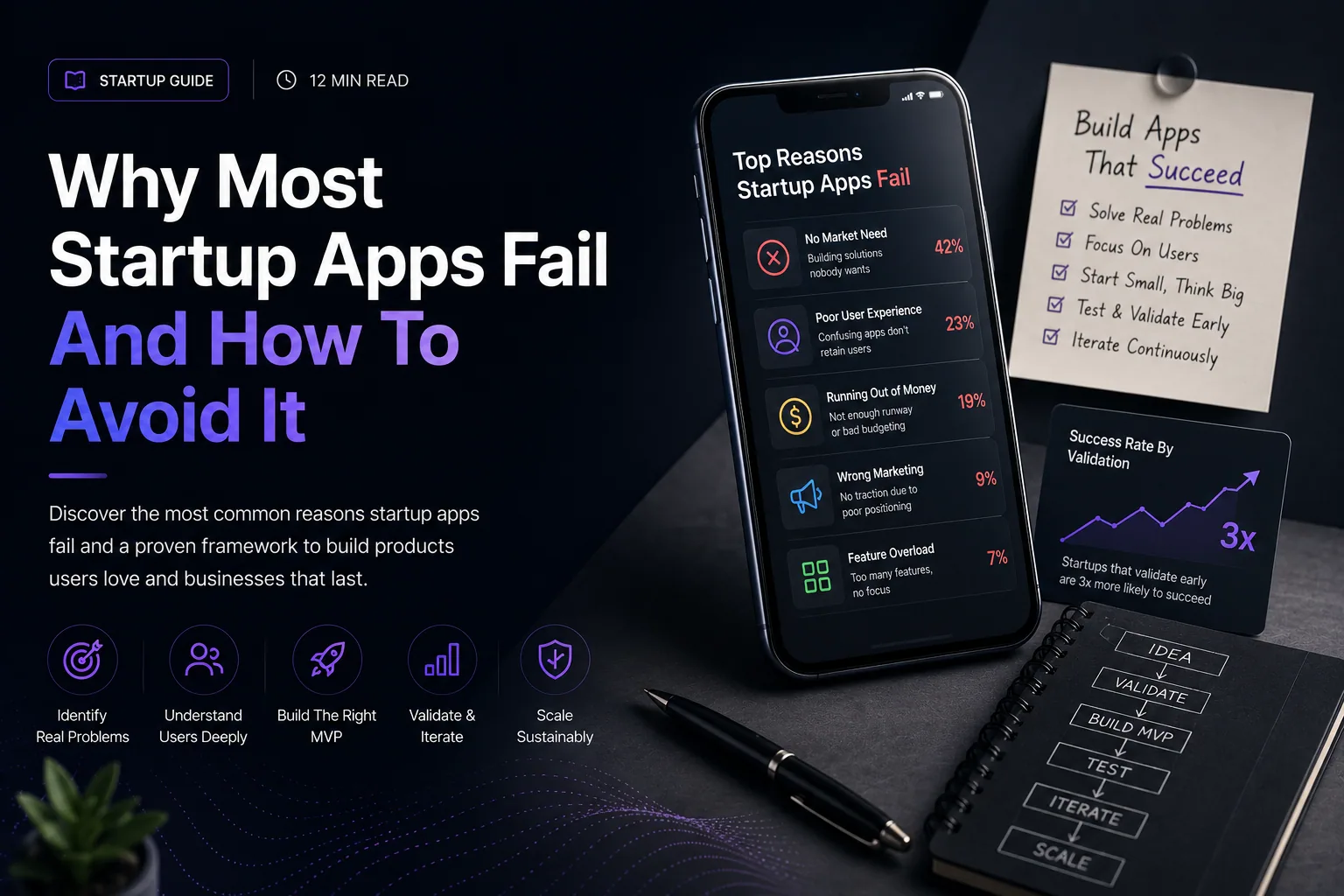
Startup apps rarely fail because the code was bad. They fail because version one tried to do too much, because nobody could find the app in store search, and because development stopped at launch — right when the store algorithms, OS updates and user feedback demanded it continue.
The failure nobody blames
When an app dies, the post-mortem always blames the idea or the market. Having built apps for founders for seven years — and watched what happened to them after handover — I think three quieter killers do most of the damage. All three are preventable, and none of them are about code quality.
Killer #1: version one was three apps in a trench coat
Almost every founder's first feature list is roughly double the size of what version one should be. I now treat cutting that list as the first deliverable of any project — before design, before code.
The damage from an oversized v1 is not just money. It is time-to-learning. A 5-screen app in users' hands in eight weeks teaches you more than a 15-screen app in six months, because the market feedback starts six months earlier. The most successful build I have been part of was also one of the most aggressively cut.
The test I use: for every feature, ask "would the app be unusable without this on day one?" Not less useful — unusable. Everything that survives is v1. Everything else goes on the after-launch roadmap, where real user behaviour will quietly delete half of it.
Killer #2: nobody could find the app
This is the failure I have the most data on, because I run BrightAppData, an App Store Optimization tool. The pattern is brutally consistent: founders spend their entire budget building the app and treat the store listing as a form to fill in on submission day.
But the listing is the marketing for most apps. Store search is where the majority of installs originate, and the listing's keywords, title, screenshots and description decide whether the app appears at all.
| Listing element | What it decides | Typical founder effort |
|---|---|---|
| Title + subtitle keywords | Whether you appear in search at all | Five minutes on launch day |
| Screenshots | Whether a viewer installs | Screengrabs, no captions |
| Keyword field / description | Which queries you rank for | Copied from the website |
| Ratings velocity | Ranking position and conversion | Left to chance |
ASO is not a launch-day task. Keyword research should happen before development — sometimes what people actually search for should change what you build. That research is exactly why I built an ASO product, and why it is part of my app work rather than an add-on.
Killer #3: launch day was treated as the finish line
An app that stops shipping updates does not stay still — it decays, and the platforms now enforce this. Google requires apps to keep up with recent Android API levels or lose visibility. Apple removes long-outdated apps under its App Store Improvements policy. Each September's iOS release breaks some dependency somewhere.
Meanwhile the real product work only starts at launch: real users reveal which features matter, crash reports reveal what testing missed, and reviews reveal what confused people. The founders who win treat the first year after launch as half the project. The ones who fail celebrate on launch day and go quiet.
This failure mode is structural when apps are bought as one-off projects — the developer's incentive ends at handover. It is the entire reason I sell App Development as a Service as a monthly subscription: the incentive stays aligned with the app staying alive.
What prevention actually looks like
- Cut v1 in half. Use the "unusable without it" test. Budget saved goes to the after-launch year.
- Do ASO keyword research before development. What people search for is evidence about what to build.
- Validate before building at all — a landing page and twenty conversations cost nothing next to a dead app.
- Budget the year after launch like it is half the project. Because it is.
- Choose a stack you can hire for. React Native's hiring pool is an insurance policy against your developer disappearing.
If you have an idea and want a straight answer on what its v1 should be — tell me about it. Cutting feature lists is genuinely the most valuable thing I do, and the conversation costs nothing.
⚠Mistakes to Avoid
- ✕Building the full vision as version one instead of the smallest usable product
- ✕Writing the store listing on submission day with no keyword research
- ✕Spending the entire budget on the build and nothing on the year after launch
- ✕Ignoring crash reports and reviews — the cheapest user research you will ever get