How Founders Can Validate An App Idea Before Spending $50,000

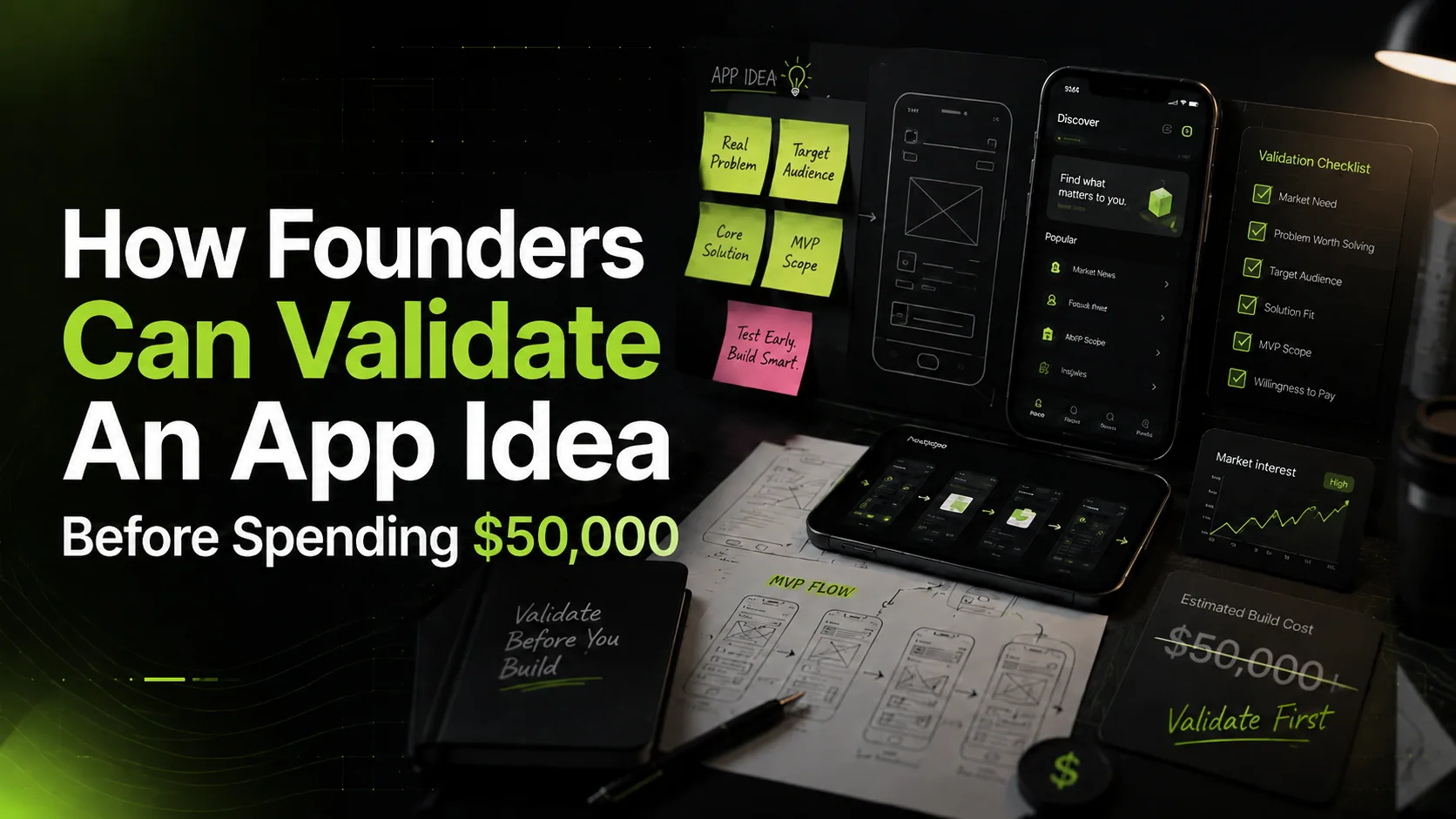
Validate an app idea by climbing a ladder of cheap tests: search demand, twenty real conversations, a landing page with a waitlist, a clickable prototype — then a $5,000-12,000 MVP. Each rung earns the right to spend on the next. Most ideas should die on rung two, cheaply.
A developer telling you not to build yet
I make money when founders build apps. So read this with that bias in mind — and notice that the advice still says wait. The reason is selfish in the long run: a client whose app dies in month three never comes back and never refers anyone. The ones who validated first do both.
Here is the ladder I actually recommend, with what each rung costs and — more importantly — what it proves.
The validation ladder
| Rung | Cost | Time | What it proves |
|---|---|---|---|
| 1. Search demand | Free | An evening | People already look for this |
| 2. Twenty conversations | Free | 1–2 weeks | The problem is real and painful |
| 3. Landing page + waitlist | ~$100 | 1 week | Strangers will give an email for it |
| 4. Clickable prototype | $500–2,000 | 1–2 weeks | The solution makes sense to users |
| 5. Concierge test | Your time | 2–4 weeks | People want the outcome, done manually |
| 6. MVP | $5,000–12,000 | 6–10 weeks | People use — and ideally pay for — the real thing |
Rung 1: check if anyone is searching
Before anything else, check whether people already search for the problem you solve — in Google and, critically for apps, in the app stores themselves. Store search is where most installs originate, and store keyword data tells you both whether demand exists and what words it uses. This is literally what my ASO tool BrightAppData does, and it is free — an evening spent there beats a month of guessing.
Two outcomes matter. High demand plus weak incumbents: excellent. Zero searches anywhere: not necessarily fatal, but it means you also carry the cost of creating demand, which multiplies the marketing budget.
Rung 2: twenty conversations that are not pitches
Talk to twenty people who have the problem. The discipline is asking about their current behaviour, never about your idea: "how do you handle X today?", "what have you tried?", "what does that cost you?". The moment you pitch, people get polite — and polite validation is how $50,000 mistakes feel safe.
What you want to hear is workarounds: spreadsheets, WhatsApp groups, hired help. A workaround is paid-for proof the pain is real. If nobody has one, the problem probably is not painful enough for an app.
Rungs 3–4: make strangers do something small
A landing page describing the app, with a waitlist form, answers a colder question: will people who do not love you spend ten seconds of effort on this? Drive a small amount of traffic at it. Signups from strangers mean something; a hundred visits and zero signups is an answer too, and it cost you about $100.
A clickable prototype — designed screens wired together, no code — then tests whether your solution makes sense. Put it in front of ten people from rung 2 and watch them navigate without help. Every place they get lost is a bug you fixed before it was code.
Rung 5: the concierge test almost nobody runs
Deliver the app's outcome manually to a handful of users. Booking marketplace? Take bookings over WhatsApp and coordinate providers yourself for two weeks. It does not scale — that is the point. It proves people want the outcome before you automate it, and the manual work teaches you the real workflow better than any spec. This is the highest-signal rung on the ladder, which is exactly what a good MVP scope comes from.
Rung 6: now build — small
If the idea climbed every rung, you have keyword data, twenty interviews, a waitlist, a tested prototype and a manual dry run. Now a $5,000–12,000 MVP is a calculated bet instead of a $50,000 hope — and the scope conversation is short, because the ladder already wrote it.
That is the point where I build it — in React Native, both stores, with the store listing built from the keyword research you did on rung one.
The uncomfortable summary
Most ideas should die on rung two, at a cost of a few evenings. That is the ladder working. If yours climbs all six, bring me the evidence — an MVP scoped from real validation is the most fun kind of project there is, and the most likely to still exist in two years.
⚠Mistakes to Avoid
- ✕Pitching the idea in interviews instead of asking about current behaviour
- ✕Treating encouragement from friends and family as validation
- ✕Skipping straight to a full build because the idea feels obviously good
- ✕Validating the app concept but never checking store search demand