The Real Cost Of Building A Mobile App In 2026

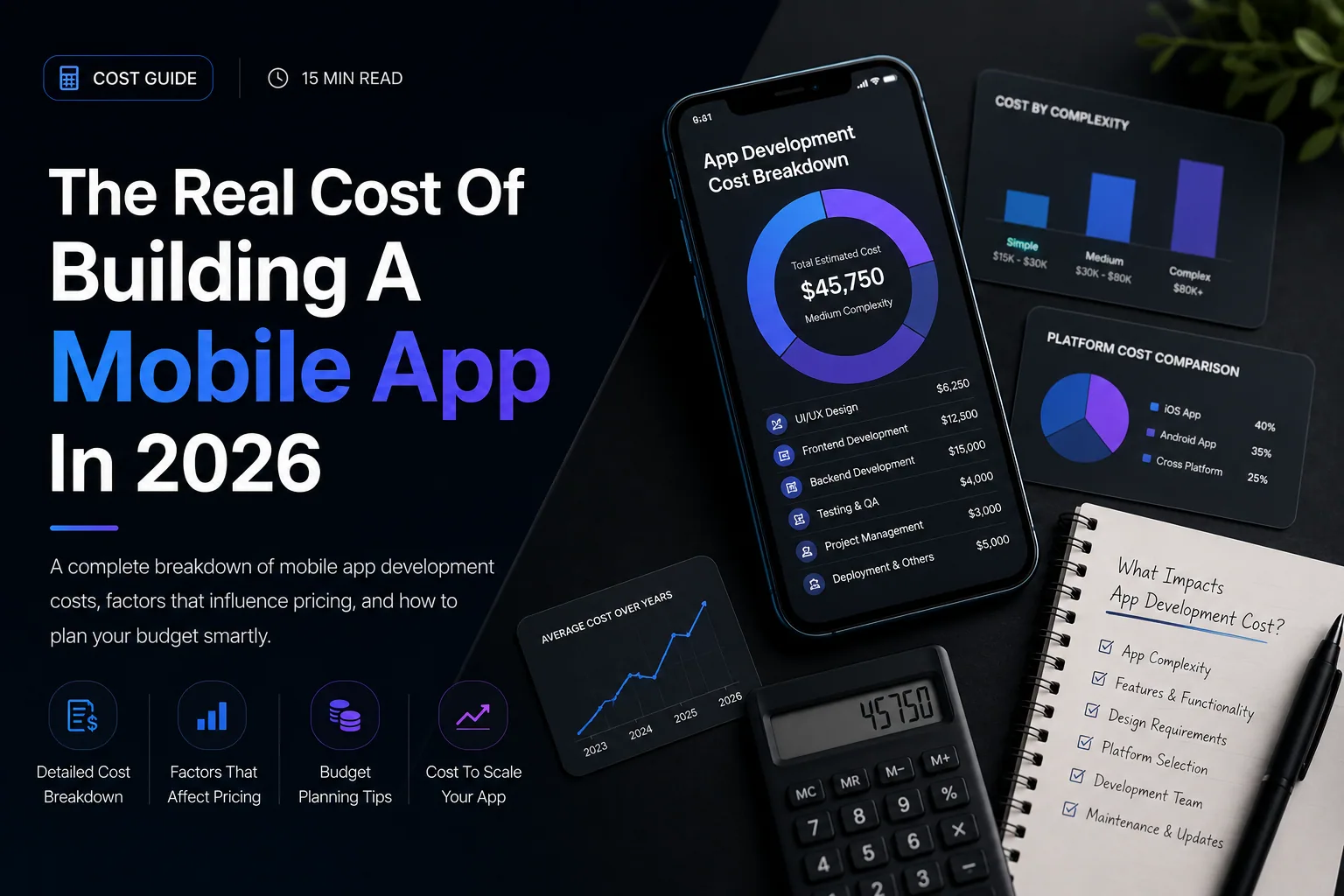
A focused two-platform MVP built in React Native typically lands between $5,000 and $12,000. A feature-heavy product runs $25,000-60,000, and separate native iOS and Android teams roughly double any quote. The biggest cost driver is not technology — it is a feature list that was never cut.
The honest answer nobody puts on a pricing page
Most agencies answer this question with "it depends" and a contact form. That protects their margin, not your budget. So here are the ranges I actually work with, and what moves a project from one band to the next.
I build apps for a living — Telemed, Zurex, a privacy-focused AI writing app and E-Foot are all live products — and I run two companies in this space, so these numbers come from quoting real projects, not from aggregating other people's blog posts.
Cost by app type in 2026
| App type | Typical range | Timeline | Example scope |
|---|---|---|---|
| Validation MVP | $5,000 – $12,000 | 6–10 weeks | 3–5 core screens, auth, one payment or booking flow |
| Standard business app | $12,000 – $25,000 | 10–16 weeks | Booking app like Zurex: services, scheduling, notifications |
| Feature-heavy product | $25,000 – $60,000 | 4–6 months | Marketplace or telemedicine-class app: two user roles, real-time features, payments |
| Separate native builds | Roughly 2× any row above | Nearly double | Two codebases, two teams, every feature built twice |
These assume a senior freelancer or small team. A US or UK agency quotes the same scope at three to five times these figures — you are paying for their office, their account managers and their sales cycle, none of which ship code.
The fees nobody mentions in the quote
Two costs exist on every single app project and rarely appear in estimates:
- Apple Developer Program: $99 per year, billed by Apple directly (developer.apple.com). Without it your app cannot exist on the App Store.
- Google Play Console: $25, one time (play.google.com).
Add the running costs people forget: backend hosting ($10–100+/month depending on scale), push notification infrastructure, and — the big one — maintenance. Apple and Google each ship a major OS release every year, and both stores now remove or restrict apps that stop being updated. Google enforces a minimum target API level annually; Apple removes long-outdated apps under its App Store Improvements policy. An app you stop maintaining does not stay still. It decays.
That last point is why I sell App Development as a Service as a monthly plan rather than a one-off build — the build is roughly half the true cost of a successful app.
What actually drives the price up
After quoting dozens of these, the pattern is consistent. In rough order of impact:
- Number of user roles. A patient-and-doctor app like Telemed is two products sharing a backend. Two roles nearly doubles the surface area.
- Real-time anything. Chat, live tracking, live scores — real-time infrastructure is a step change in complexity, not a feature.
- Payments. Card processing itself is easy now. Payouts, refunds, subscription edge cases and App Store commission rules are where the hours go.
- Offline support. "It should work offline" is one sentence that can add weeks. Sync conflicts are genuinely hard.
- Custom design. A designed-from-scratch UI versus a clean standard interface can be a 30–40% swing on the front-end budget.
Notice what is not on the list: the choice between iOS and Android. With React Native, that choice stopped being a cost driver — you get both from one codebase, which is exactly why I default to it for startups.
Where founders waste the most money
Not on rates. On scope.
Almost every first feature list I receive is roughly twice the size of what version one should be. The most valuable hour of any project I take on is the one where we cut that list — and it is the reason a $10k build with me starts with an argument about what not to build. Features you ship to nobody are the most expensive kind.
The second-biggest waste: paying for two native teams before the idea is validated. Native Swift and Kotlin have real advantages — for Bluetooth-heavy hardware work, background processing, high-end graphics. If your app is one of those, hire a native developer, even if that is not me. For everything else, building twice before you have users is burning runway for an engineering ideal your customers cannot see.
How to budget it sensibly
Take the MVP range, add the store fees, then budget the same amount again for the twelve months after launch — features, fixes, OS updates and store compliance. If the total breaks your budget, the answer is not a cheaper developer. It is a smaller version one. Validate the idea first, then spend.
If you want a real number for your specific idea instead of a range, tell me what the app has to do — you will get a scope, a timeline and an honest figure, including "don't build this yet" if that is the truth.
⚠Mistakes to Avoid
- ✕Paying for two native teams before the idea has a single real user
- ✕Judging quotes on price alone — the expensive part is the rebuild after a cheap build fails
- ✕Forgetting the year-two costs: OS updates, store compliance, dependency upgrades
- ✕Shipping the full feature list in version one instead of cutting it in half