AI App Development: What Founders Need To Know Before Building

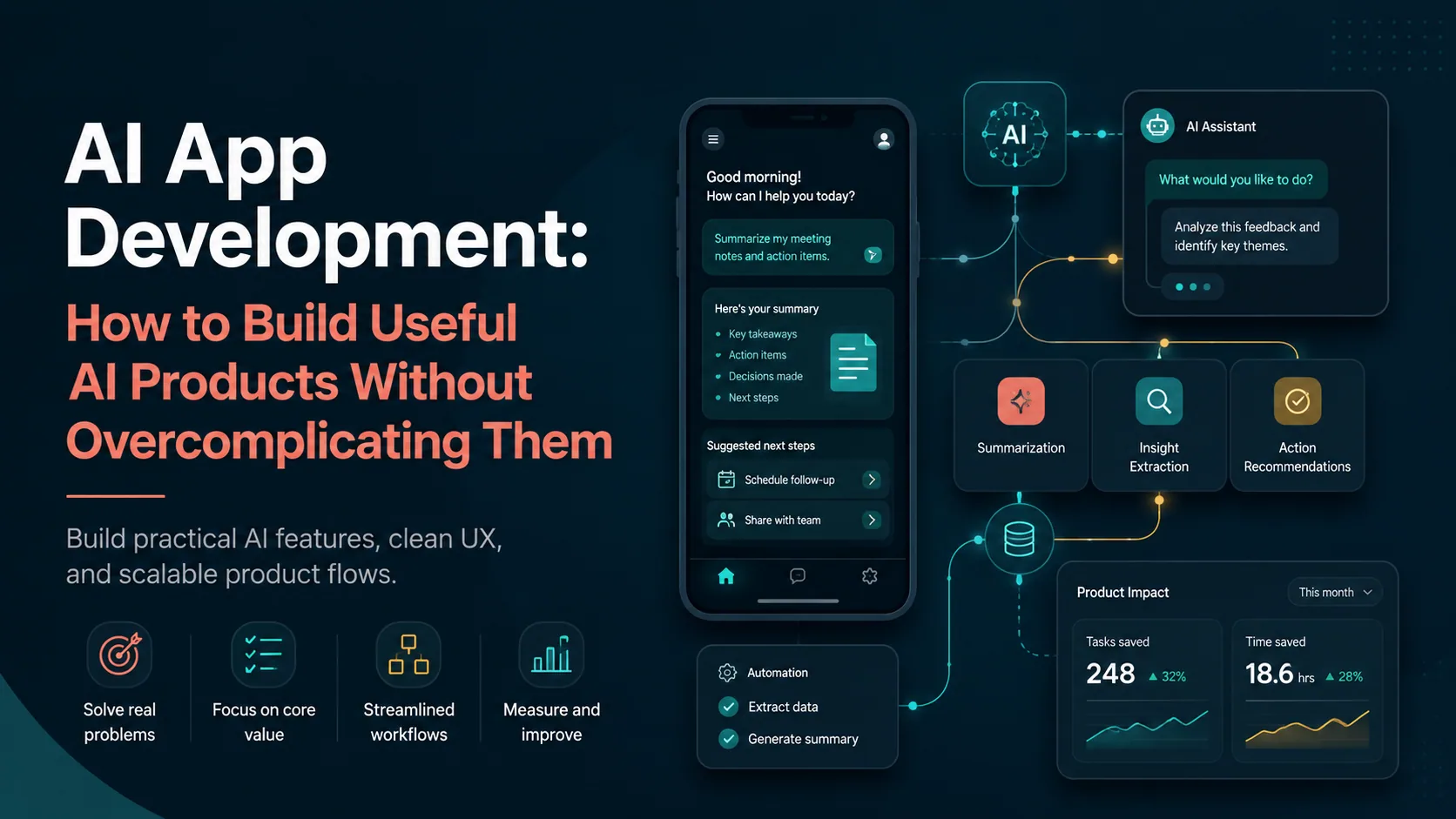
Building an AI feature into a mobile app is now an integration problem, not a research problem. The decisions that matter are on-device versus cloud inference, per-user API costs at scale, and store privacy rules. The failure mode is bolting on a chatbot nobody asked for.
I shipped one, so this is field notes
One of my four production apps is a privacy-focused AI writing app — built specifically so drafts stay private rather than being shipped to a server by default. That project forced every decision this article covers, so what follows is field notes, not theory.
The one decision that shapes everything: where the model runs
| On-device AI | Cloud AI (API) | |
|---|---|---|
| Privacy | Data never leaves the phone | Every request reaches a server |
| Cost at scale | Free per use after shipping | Every user action bills you |
| Capability | Small models — limited but improving fast | Frontier models, full capability |
| Offline | Works | Doesn't |
| Latency | Instant | Network round-trip |
| App size | Model ships in the binary — bigger download | Small |
My writing app leans on-device precisely because privacy was the product. Most apps land on a hybrid: small fast tasks on-device, heavy generation in the cloud. The mistake is not choosing consciously — defaulting to "call the API for everything" and discovering the consequences in your first invoice and your App Store privacy label.
The API bill grows with success — plan for that on day one
Cloud AI pricing looks harmless per request and becomes your biggest line item at scale, because it scales with usage, not with users. A founder budgeting $200/month for AI costs at validation stage needs to know what the same usage pattern costs at 10,000 users — before committing to a free tier.
Practical defenses I build in from the start: cache aggressively (identical requests should never bill twice), cap per-user usage on free tiers, use the smallest model that does each job, and put every AI call behind your own backend so you can switch providers without a store release. That last one has saved projects: model pricing and quality shift every quarter, and being locked to one vendor through hardcoded client calls is a completely avoidable trap.
The stores treat AI apps as privacy-sensitive — because they are
Apple requires every app to declare exactly what data it collects in its privacy label, and text sent to an AI API is user content leaving the device. Google's data safety section works the same way. Declare it wrong and the review team catches it — or worse, catches it later and pulls the app.
If your users will type anything sensitive — health notes, legal drafts, business documents — privacy is not a compliance checkbox, it is a product decision. It is the entire reason the writing app I built processes on-device. "Your data never leaves your phone" is a sentence marketing cannot fake and competitors relying on cloud APIs cannot copy.
When the AI feature is a gimmick
The honest test: does the app's core job get done better because the AI is there? A writing app that improves drafts — yes, that is the product. A booking app with a chatbot bolted on because investors expect AI — no, and users smell it immediately.
Gimmick AI actively costs you: API bills for a feature nobody uses, a privacy label that got scarier, review risk, and a diluted store listing. If the AI feature disappeared tomorrow and your retention would not move, cut it and ship faster. Real AI features, meanwhile, are becoming table stakes in categories like writing, photo editing and language learning — the bar is "meaningfully better at the core job", not "has AI".
What this means for your build
An AI-powered MVP is not automatically more expensive than a normal one — integration against an API is well-trodden work now, and React Native handles it exactly like any backend. The cost risk is operational (the API bill) and the schedule risk is scope, same as every app.
If you are weighing an AI app idea, send me what it should do — I will tell you where the model should run, what the usage economics look like, and whether the AI part is the product or the gimmick. I have made those calls on a shipped product, which is rarer advice than it should be.
⚠Mistakes to Avoid
- ✕Hardcoding one AI provider into the app instead of routing through your own backend
- ✕Budgeting API costs at launch scale instead of target scale
- ✕Bolting a chatbot onto an app whose core job does not need it
- ✕Misdeclaring App Store privacy labels for data sent to AI services